

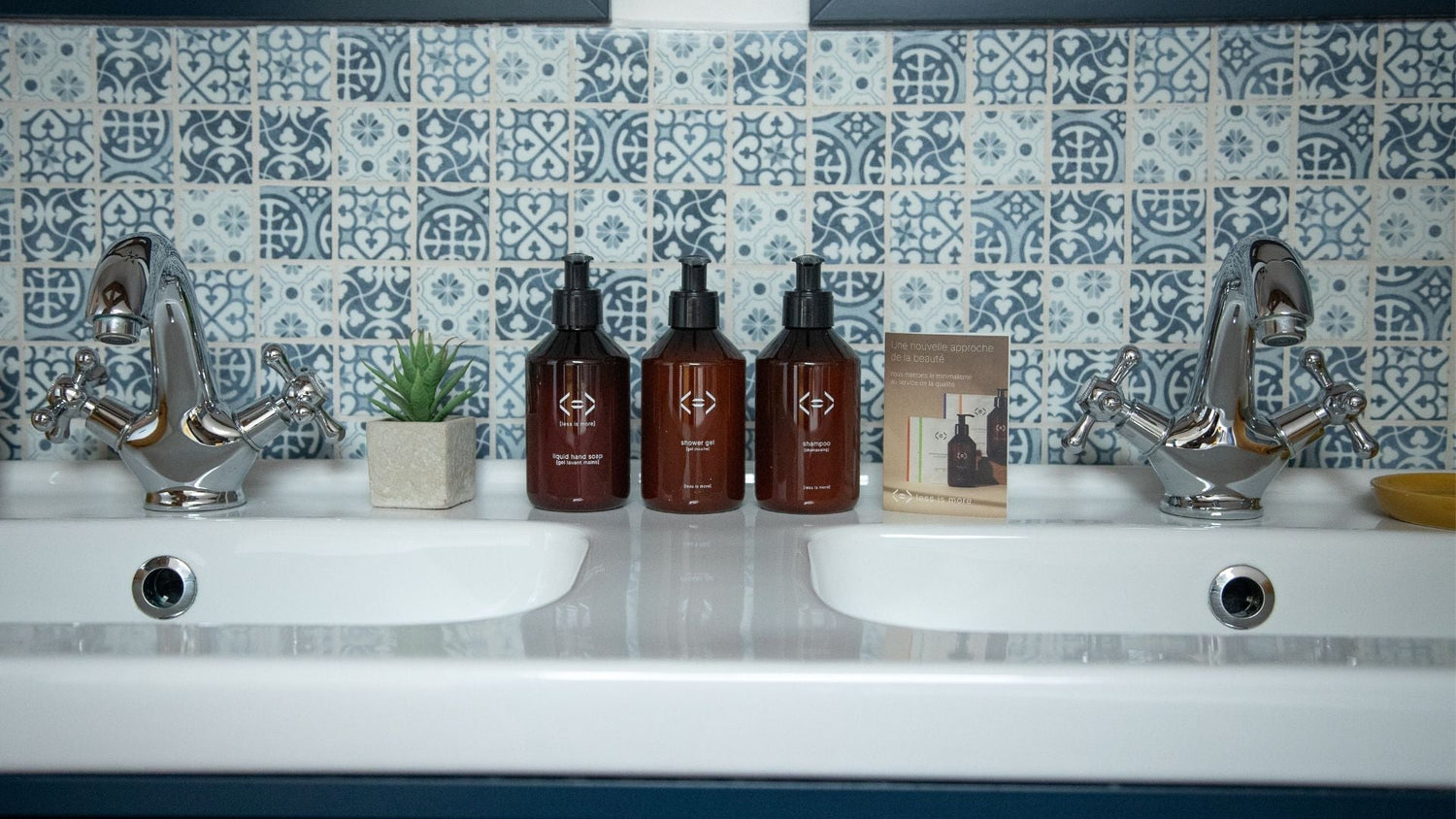
For decades, guest toiletries were a line item nobody thought about — order the miniatures by the case, restock the housekeeping trolley, move on. That era is ending. Regulation is tightening, guests have started to notice what's in the bathroom, and the humble amenity has quietly become a point where cost, sustainability and brand all meet. This guide is about how to choose well: the real costs to weigh, what guests now expect, and the criteria that separate a considered amenity from a forgettable one. We make refillable amenities ourselves, so we'll use our approach as an example — but the framework applies whatever you end up buying.
The hidden cost of conventional amenities
The price per miniature on your invoice is the smallest part of the story. Three costs stay invisible until you look for them.
You're paying to ship water. A standard liquid shampoo or shower gel is 80 to 90% water. Every truck, every pallet, every shelf of stock is mostly water wrapped in plastic — transported across the country, stored in your reserves, and ultimately rinsed down a drain. It's an inefficiency baked into the format itself.
The volumes are larger than they feel. A single 50-room property gets through an estimated 15,000 to 30,000 plastic miniatures a year. Multiply that by the storage space, the delivery frequency, the housekeeping handling and the waste-disposal cost, and a “cheap” amenity turns out to carry a substantial operational tail.
The carbon and waste sit on your ESG ledger. Single-use toiletries are increasingly counted — by corporate-travel buyers, by MICE tenders, by sustainability certifications — as part of your environmental footprint. What used to be invisible is now something you may have to report on and defend.

What guests now expect
Guest expectations have moved faster than most amenity contracts. A bathroom lined with throwaway plastic no longer reads as generous; to a growing share of travellers it reads as careless. Business travellers, and millennial and Gen-Z guests in particular, increasingly notice sustainable practices and factor them into reviews and rebooking. At the same time, the definition of “premium” is shifting: luxury is no longer an accumulation of little bottles but a sense that everything in the room was chosen deliberately — including what's by the basin. A well-considered amenity now does double duty as a sustainability signal and a brand cue guests actually remember.
What actually makes a good hotel amenity
Once you look past the packaging, five things separate a quality amenity from a commodity one. Use them as a checklist.
Formulation. This is where most hotel amenities quietly disappoint. Look at the ingredient list the way a discerning guest would: avoid harsh sulfates (SLS/SLES) that strip and dry the skin, silicones that coat hair and build up, and parabens, PFAS and synthetic colorants. Check the pH — skin and hair sit around 5.5, and a product balanced to that range cleanses without disrupting the skin barrier, which matters across a guest base with every skin and hair type. Naturally derived formulas are also kinder to the waterways your greywater feeds into.
Sensory quality. Fragrance and texture are the two things a guest actually experiences, and they're disproportionately tied to memory. A distinctive, well-composed scent and a rich texture make an amenity feel intentional — and can become something guests associate specifically with a stay at your property. A flat, generic bulk refill does the opposite.
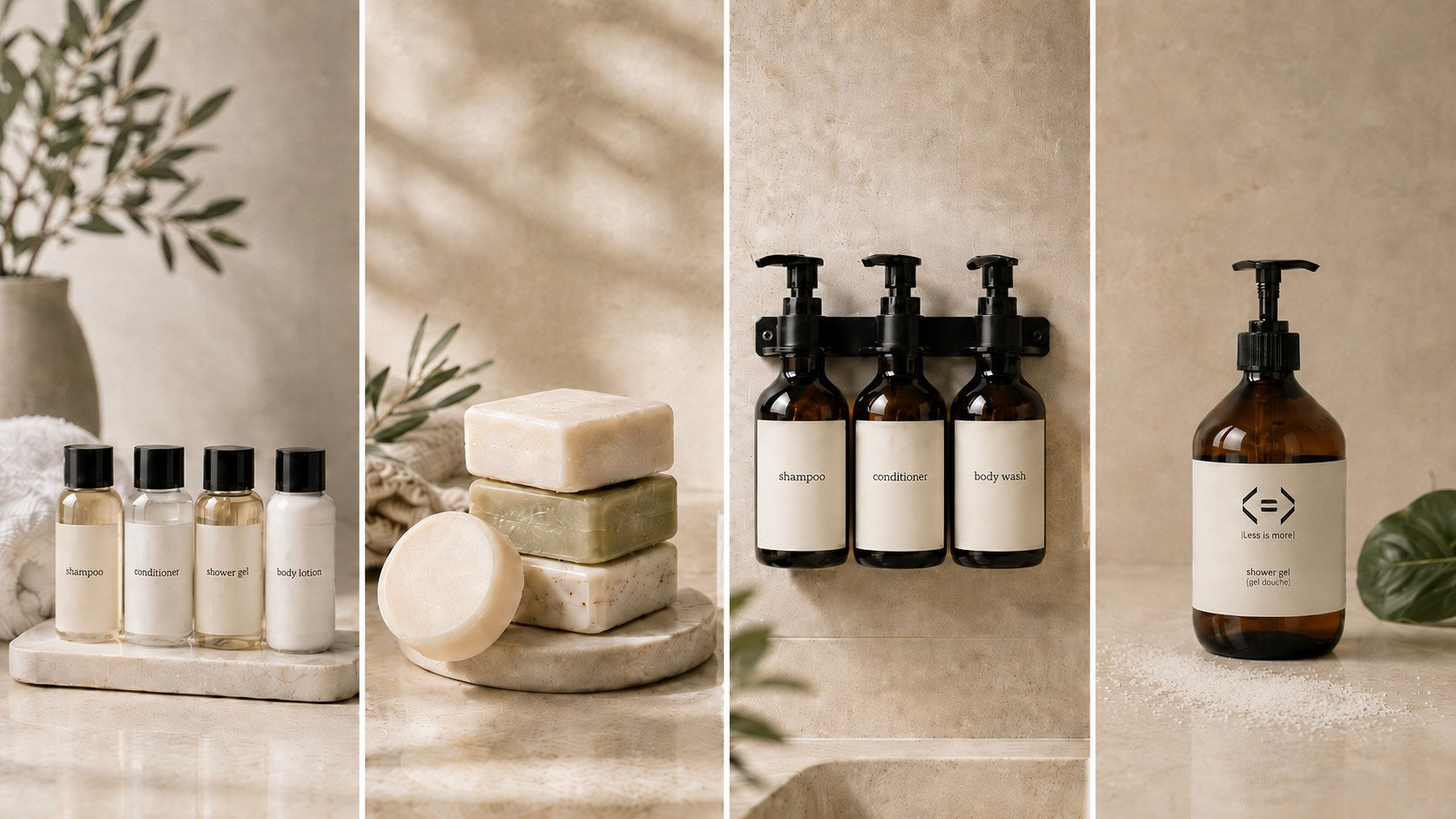
Format and hygiene. The single-use miniature is on its way out; the practical question is which refillable route fits your property. Reusable bottles and wall-mounted dispensers both cut waste dramatically; the trade-offs are around housekeeping speed, tamper-security and how the format looks in your bathrooms. Whatever you choose, favour systems with a clear refill-and-traceability protocol so hygiene and consistency are controlled.
Credible sustainability. “Recyclable” on a label is not a sustainability strategy. Look for substance you can point to: where the product is made (local manufacturing cuts transport emissions), what the packaging actually is and does, and whether there's real life-cycle logic behind the claims — not just green design. Concentrated and powder-to-liquid formats go furthest here, because removing the water removes most of the weight, packaging and transport at once.
Brandability. The best amenity programmes are also a branding surface. Custom labelling, a curated fragrance, or even an exclusive signature scent turn a compliance necessity into a differentiator — particularly for boutique, design and luxury properties where every detail is deliberate.
A quick checklist: Is the pH close to 5.5? Is it free of harsh sulfates, silicones, parabens and PFAS? Is the fragrance something you'd want associated with your brand? Is the format refillable with a clear protocol? Can you verify the sustainability claims? Can it carry your identity? If you can answer yes across the board, you have a genuine amenity — not just a cheaper bottle.

How we approach it at Less is More
Our range is built directly around those criteria. We use a powder-to-liquid format — a concentrated powder activated with water on-site — so you stop shipping and storing water, cut up to 90% of amenity storage volume, and reduce delivery frequency several-fold. The formulas are made in France from naturally derived ingredients, pH-balanced, silicone-free and free of harsh sulfates (SLS/SLES), and vegan.
In practice that's three products designed to work as a set: a shower gel (pH ~5.5, rich creamy lather), a shampoo suitable for all hair types without the coated feel of conventional formulas, and a gentle hand soap for bathrooms and shared spaces. They come as reusable bottles or wall-mounted dispensers, with fragrances developed with perfumers Isabelle Abram and Mara Penchansky — or an exclusive scent developed for your property — and custom labelling for hotels that want their identity on every bottle.
Where the regulation fits
Choosing better amenities isn't only a guest-experience call; from 2030 it's a compliance one. The EU's PPWR regulation phases out single-use guest toiletries in hospitality, and a refillable programme puts you ahead of it years early. We've written a full guide to what the regulation requires and by when: The end of hotel miniatures — what the PPWR means for hospitality →
Want to put the checklist to the test? Request free samples and a proposal tailored to your property →
FAQ — choosing hotel amenities
What should I look for in a hotel amenity?
Formulation first: a pH close to 5.5 and no harsh sulfates (SLS/SLES), silicones, parabens or PFAS. Then sensory quality (a fragrance and texture worth remembering), a refillable format with a clear hygiene protocol, credible sustainability you can verify, and the option to carry your brand.
Are refillable amenities more expensive than miniatures?
Per-unit they can look similar, but the total cost is usually lower once you account for storage, delivery frequency, handling and waste — and concentrated/powder formats cut those further by removing the water weight.
What ingredients should hotels avoid in toiletries?
Harsh sulfates (SLS/SLES), silicones, parabens, PFAS and synthetic colorants are the main ones to screen out — they're common in low-cost amenities and the first things a label-reading guest will notice.
Can hotel amenities be customised to our brand?
Yes — fragrance, dispenser/bottle format and custom labelling can all be tailored, and an exclusive signature scent can be developed for properties that want a unique identity.
Is there a minimum order for hotels?
No. We supply small independents and large groups alike, and send free samples plus a tailored proposal before any commitment.
Read also: Beyond miniatures: the six amenity systems compared →





Leave a comment
This site is protected by hCaptcha and the hCaptcha Privacy Policy and Terms of Service apply.