

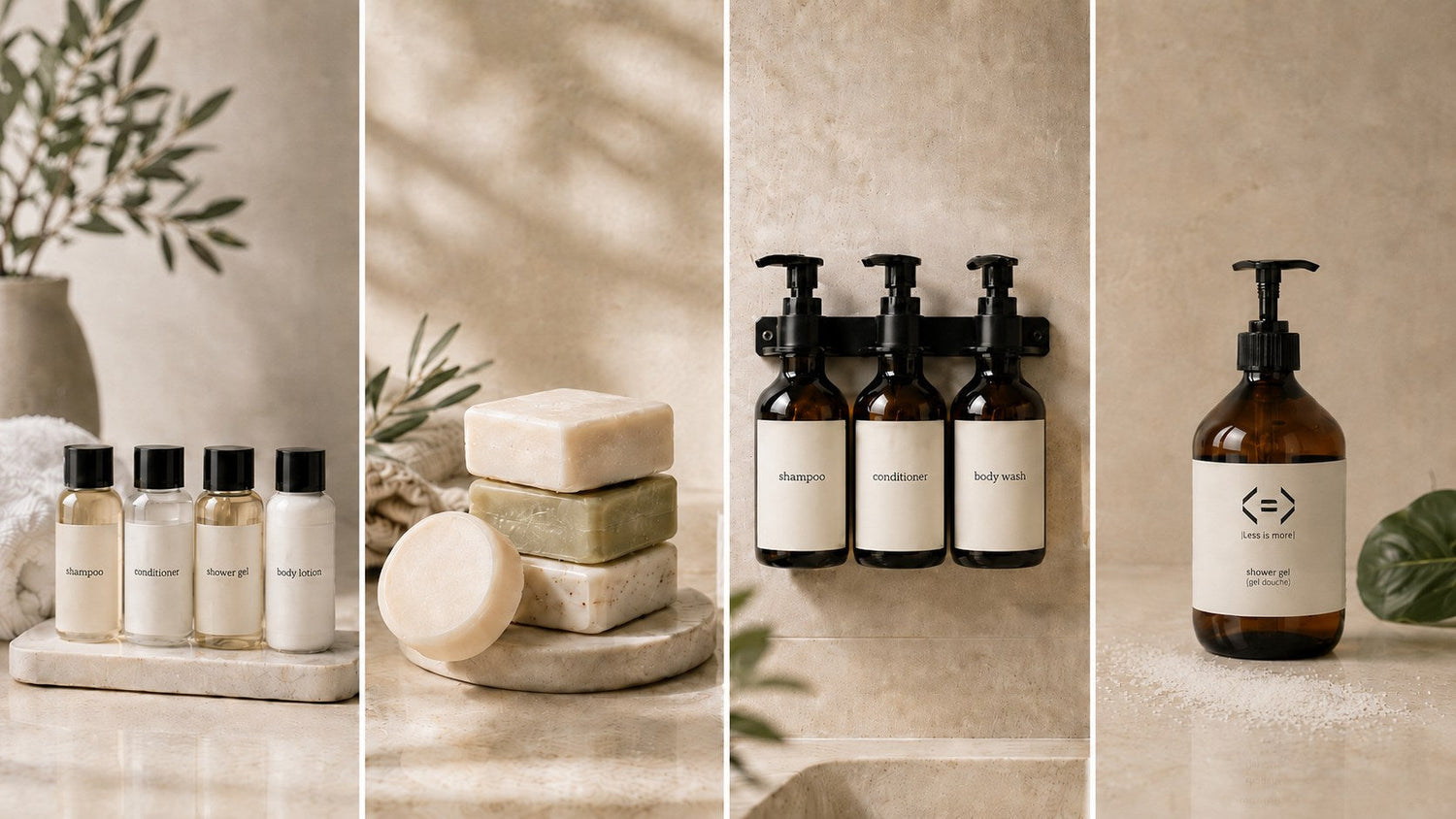
The single-use miniature had a good run. It was familiar, required zero thought, and some guests even took the little bottles home. But between the EU's PPWR regulation phasing it out from 2030 and guests who increasingly read a wall of throwaway plastic as careless rather than generous, most hoteliers are now asking the same question: replace it with what?
Before comparing the options, it's worth naming the question that actually matters underneath the packaging debate: where does your money go? Every euro spent on a bottle, a cap, a seal, or on shipping water across the country is a euro not spent on the formula inside — and the formula is the only part a guest actually touches, smells and remembers. A lot of hotel amenities are quietly mis-allocated: most of the cost sits in the container and the logistics, and what's left over buys a mediocre liquid. The most useful way to compare the six realistic alternatives is to ask, for each, how much of your spend reaches the guest's actual experience — and, increasingly, how well you can trace what you're putting in the room.
A disclosure up front: we make powder-to-liquid amenities, so we have a horse in this race. We've tried to give each option its genuine strengths and its genuine drawbacks, ours included.
The six options at a glance
| System | Waste reduction | Storage & shipping | Where the money goes | Traceability | PPWR-ready |
|---|---|---|---|---|---|
| Single-use miniatures | Poor | Heavy (ship water + bottles) | Mostly packaging, weak formula | Per sealed unit | No |
| Solid bars | Excellent | Light | Mostly formula, but wastage claws it back | Batch-level | Yes |
| Bulk-liquid dispensers | Good | Still heavy (ship water) | Hardware + bulk logistics, often a generic liquid | Needs a protocol | Yes |
| Liquid refill pouches | Good, minus 10–15% wasted | Still heavy (ship water) | Packaging + water, often a generic liquid | Excellent (batch code per pouch) | Yes |
| Refillable bottles | Good | Still heavy (ship water) | Bottles + water logistics | Needs a protocol | Yes (if genuinely reused) |
| Powder-to-liquid | Excellent | Very light (no water shipped) | Shifts toward formula & fragrance | Batch-level (pre-portioned) | Yes |
The rest of this article unpacks each row.
1. Single-use miniatures: the incumbent, on the way out
How it works: small individually sealed bottles, one guest, then discarded.
Advantages. They're familiar and need no hardware, guests know exactly what to do with them, and there's a small charm factor — a nicely branded miniature occasionally goes home as a keepsake, which is a little piece of brand recall. For a very small property, the simplicity is real.
Drawbacks. The economics are the real problem, and they're the opposite of what "cheap miniature" suggests. You buy a complete new bottle, cap and seal for every single use — so a large share of what you pay goes into packaging, not into the product. That leaves little budget for the formula, which is exactly why so many miniatures contain a thin, forgettable liquid. It's a structural mis-allocation: you're spending on the container the guest throws away and skimping on the part the guest actually experiences. Add the cost of shipping bottles that are 80–90% water, the storage and the waste — and the fact that the PPWR bans this single-use format outright from 2030 — and this is simply the option everything else is measured against.
Best for: essentially no one going forward — even the smallest properties are only buying time until the 2030 ban.
2. Solid bars: low-waste, with one stubborn dilemma
How it works: shampoo bars, conditioner bars and bar soap, usually unpackaged or in minimal paper.
Advantages. Waste reduction is the best of any option, often zero plastic, and because there's almost no packaging to pay for, more of your spend can go into the formula itself. No hardware, compact storage, low and predictable cost, and a clear environmental signal that a certain guest loves.
Drawbacks. There's one dilemma solid bars never fully escape, and it's about turnover between guests. Either you leave a part-used bar in the room for the next guest — which looks unappealing and few travellers will accept — or you replace it every stay, which throws away a mostly-full bar each time. The second path quietly puts you back into single-use economics and waste, just in solid form. On top of that, guest acceptance is genuinely divisive (a bar behaves differently from liquid and some guests simply won't use it), and bars perform inconsistently in hard-water regions.
Best for: eco-positioned, independent and boutique properties whose guests actively opt into a sustainability story — less suited to upscale or business hotels with more conventional expectations.
3. Bulk-liquid dispensers: the apparent obvious choice
How it works: fixed wall-mounted dispensers refilled from large containers of liquid shampoo, gel and soap.
Advantages. Compared with miniatures, the waste reduction is real and immediate, refilling in place is straightforward, and the cost per wash is low. On the surface it looks like the obvious answer to the miniature problem.
Drawbacks. It appears the obvious choice, but several drawbacks sit just underneath. First, perception: a dispenser can read as "budget" or "gym" if the hardware and the liquid inside are generic — a downmarket association the format has to actively overcome. Second, and more fundamental, it doesn't fix the underlying inefficiency. You're still shipping and storing large volumes of water-heavy liquid, so the logistics and storage burden barely improves over miniatures. And the money simply moves rather than reaching the guest: instead of packaging, your spend goes into hardware and bulk logistics, and the liquid poured into most dispensers is a low-cost generic. The guest still experiences an unremarkable formula — you've solved the plastic without solving the value allocation. Open-bulk refilling also puts more responsibility on you for traceability (more on that below).
Best for: hotels that want a proven, low-friction switch — provided they pair it with genuinely good hardware and a quality liquid, rather than defaulting to the cheapest bulk fill.
4. Liquid refill pouches: easy to swap, but you throw money away
How it works: pre-filled liquid pouches that slot into a wall dispenser and are replaced as a unit, rather than pouring from an open bulk container.
Advantages. They're genuinely easy to change — pull the empty, drop in the full — and because each pouch is a sealed, pre-filled unit carrying its own batch code, traceability is excellent out of the box. That makes them a tidy operational answer for teams that want quick swaps and clean record-keeping.
Drawbacks. Two things hold pouches back, plus a familiar third. First, aesthetics: pouch-fed dispensers are frequently utilitarian and don't flatter a considered bathroom. Second — and this is the one that surprises people — you can't fully empty a pouch. Roughly 10–15% of the liquid stays trapped in the plastic and gets discarded with it at every replacement. That's product you paid for, literally thrown away, at every changeover — a hidden recurring cost and a real dent in the waste savings. And as with dispensers, you're still shipping water and the pouch liquid is often a lower-cost generic, so your spend still isn't reaching the formula.
Best for: operations that prioritise fast, traceable swaps and can accept the residual-waste and appearance trade-offs.
5. Refillable bottles: premium feel, but still shipping water
How it works: attractive reusable bottles in the room, refilled or swapped by staff between stays rather than thrown away.
Advantages. Done properly, this keeps the in-room bottle experience guests like, and a beautiful, branded refillable bottle can feel more premium than a wall fixture. Waste drops sharply if the bottles are genuinely reused many times. It's a strong fit for design-led properties that want an object in the bathroom.
Drawbacks. The core limitation is the same one dispensers have: you're still buying, shipping and storing finished liquid that's mostly water, so the storage footprint and delivery frequency stay high. There's real refilling labour between guests, and a "greenwashing" trap worth naming — a bottle that's actually replaced each stay is just a bigger single-use bottle, so the saving only materialises with disciplined reuse. Refilling in-room bottles from a bulk container is also the setup that most needs a proper traceability protocol (below). As with dispensers, much of your spend is tied up in the bottle and in moving water around, not in the formula.
Best for: boutique and luxury properties that value the in-room object and have the operational capacity to run a genuine reuse cycle.
6. Powder-to-liquid: newest, lightest, least familiar
How it works: a concentrated powder is activated with water on-site, so you don't transport or store finished liquid at all — you add the water where it's used.
Advantages. Taking the water out is where everything changes. Storage volume drops by up to ~90% and deliveries become fewer and lighter, because you're no longer shipping bottles of mostly-water across the country. Crucially, it also re-allocates the spend: with far less going into water logistics and disposable packaging, more can go into the formula and fragrance — the part the guest experiences every day. Because the powder is pre-portioned and packaged, it carries batch-level traceability. Waterless formulas can also be more concentrated and stable, and the format lends itself to a considered sensory experience rather than a generic fill. It's fully PPWR-aligned and pairs with either refillable bottles or dispensers.
Drawbacks — ours included. It's the least familiar option, so there's a education element and some novelty risk. It requires a one-time setup, and (unless you want your guests to make the powder-to-liquid mix themselves), there's an activation/mixing step for staff — fast and simple, but a change to the housekeeping routine that is guided by a clear protocol. And "add water" only makes sense where clean water is a given (true in a hotel in Europe, but worth stating). The operational and value-allocation upside is real, but it asks a property to adopt something new rather.
Best for: properties that care about storage and logistics as much as sustainability, and upscale/lifestyle hotels wanting a distinctive, premium amenity at affordable cost — provided they're open to an innovative format.
A word on traceability
As the industry moves away from sealed single-use units, one quiet requirement comes into focus: being able to trace exactly what's in each dispenser or bottle, back to a specific production batch. It matters for quality control, for guest safety and for the rare case of a product recall — and it's part of doing the switch responsibly rather than just cheaply.
Some formats handle this automatically. Sealed, pre-filled pouches and pre-portioned powder each carry a batch code, so the record follows the product into the room. The setup that needs the most attention is any open-bulk-into-bottle refilling — decanting from a large container into in-room bottles or dispensers — where, without a defined process, you can lose the link between what a guest used and which batch it came from. The good news is that this is a solved problem, not a reason to avoid refillables: refill systems and protocols exist that meet the requirements and have been approved by the appropriate bodies. The point is simply to choose one of them and monitor it, rather than improvise.
How to actually decide
Rather than a single winner, weight the axes that matter most to you:
- If waste reduction is the absolute priority: solid bars or powder-to-liquid go furthest.
- If you want the lowest-friction switch away from miniatures: bulk dispensers or refill pouches — as long as you invest the savings back into a quality liquid, not the cheapest fill, and accept the pouch's residual-waste trade-off.
- If traceability and quick swaps are top of your list: sealed pouches or pre-portioned powder give you a batch code by default.
- If in-room premium feel matters most: refillable bottles, accepting the storage and refilling overhead.
- If you want your spend to reach the guest's actual experience: the formats that stop paying to ship water and package it — solid bars and powder-to-liquid — leave the most budget for the formula.
- If you're a small or independent property: the ban applies whatever your size, but a switch is easiest to pilot at small scale — and guest expectations are shifting regardless.
One point that's easy to miss: these aren't mutually exclusive, and the system (how the product reaches the guest) is a separate decision from the product (what's actually in it). A refillable bottle or dispenser filled with a concentrated, powder-derived product combines the guest-facing feel of one with the logistics and value allocation of another.
Where we fit, and where we don't
We build powder-to-liquid amenities, so naturally we think the case for taking the water out — logistically and in terms of putting money into the formula rather than the packaging — is strong. But it isn't the right answer for a two-room guesthouse, or for a property whose guests would balk at anything unfamiliar. If that's you, a well-chosen dispenser with a genuinely good liquid is a sound, defensible choice — and a far better one than clinging to miniatures until 2029.
If you are weighing powder against the alternatives, the most useful next step is to feel the difference rather than read about it.
Curious how a powder-to-liquid amenity actually performs? Request free samples and a proposal for your property →
For the criteria that separate a good amenity product from a generic one — whichever system you choose — see our buyer's guide to hotel amenities. For the regulation driving all of this, see the end of hotel miniatures and the PPWR.
FAQ
What's replacing single-use hotel miniatures?
Six main options: solid bars, bulk-liquid wall dispensers, liquid refill pouches, refillable in-room bottles, and powder-to-liquid concentrates — plus, for a shrinking window before the 2030 ban, miniatures themselves. They differ on waste reduction, storage and logistics, traceability, cost, and how much of your spend actually reaches the formula the guest experiences.
Are miniatures really the cheapest option?
Not once you look at where the money goes. Because you buy a fresh bottle, cap and seal for every use, a large share of the unit cost is packaging rather than product — which is why the formula inside is often thin. Add shipping water, storage and waste, and the "cheap" miniature is an expensive way to deliver a mediocre experience.
Are refill pouches a good option for hotels?
They're easy to swap and give you excellent traceability, since each sealed pouch carries a batch code. The catches are that pouch-fed dispensers are often unattractive, you're still shipping water, and you can't fully empty a pouch — roughly 10–15% of the liquid is discarded with the plastic at each changeover, which is both waste and money lost.
Are wall-mounted dispensers or refillable bottles better?
Dispensers are lower-effort; refillable bottles keep the in-room object and can feel more premium but need a genuine reuse cycle to pay off. Both share the same limitation: you're still shipping and storing water-heavy liquid, so neither fully fixes storage or moves spend toward the formula.
Do hotels need to worry about traceability with refillable amenities?
It's a factor to manage, not a barrier. Sealed pouches and pre-portioned powder carry a batch code automatically; the setup that needs a defined protocol is decanting bulk liquid into in-room bottles. Approved systems and processes exist that meet the requirements — the key is to choose one and monitor it.
What's the advantage of powder-to-liquid amenities?
You stop shipping and storing water, cutting storage volume by up to ~90% and reducing deliveries — and with less money going into water logistics and packaging, more can go into the formula and fragrance. The trade-off is that it's less familiar to guests and adds a setup/activation step for staff.
Which option does the PPWR require?
The PPWR doesn't mandate a specific system — from 2030 it bans the single-use miniature format in the accommodation sector (Article 25 and Annex V), with no room-count threshold. Any of the refillable or solid options can satisfy it; the choice comes down to your guests, your operations and where you want your money to go.






Leave a comment
This site is protected by hCaptcha and the hCaptcha Privacy Policy and Terms of Service apply.