

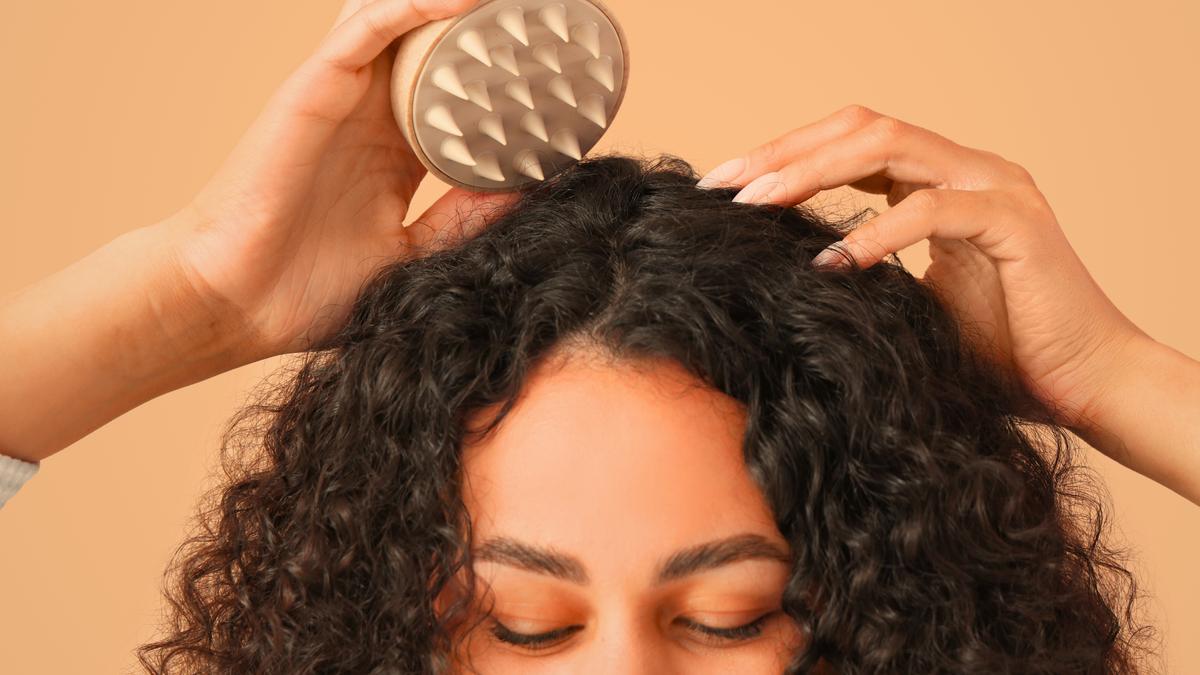
Your scalp is skin — and just like the skin on your face, it has its own natural balance to maintain. A healthy scalp sits at a slightly acidic pH (around 4.5–5.5) and hosts a delicate ecosystem of bacteria and fungi that keep it calm, protected, and functioning as it should. When that balance is disrupted — by harsh cleansers, over-washing, or product buildup — your scalp usually tells you.
Here are five of the most common signs, what's behind them, and how to bring things back into balance.

1. Why does my scalp keep flaking?
Not all flakes are the same. Dry scalp flakes tend to be small and powdery, often alongside tightness or mild itching. Dandruff flakes are usually larger, oilier, and can come with redness or a more persistent itch. The two have different causes — dry scalp is a lack of moisture, while dandruff is linked to excess oil and an overgrowth of a yeast called Malassezia — but both are signs the scalp's natural balance has tipped too far in one direction.
What can help: Avoid stripping the scalp further with harsh, high-pH surfactants, and look for a gentle, SLS and SLES-free formula that cleanses without disrupting the skin barrier.
2. Why does my scalp feel tight or itchy after washing?
A scalp that feels tight right after washing, or itches even when it looks clean, is often reacting to something in your routine — frequently sulfates like sodium lauryl sulfate (SLS), which are effective at cleansing but can also increase water loss from the skin and disturb its protective barrier.
What can help: Switching to a soap-free cleanser without SLS or SLES, formulated closer to your scalp's natural pH, can reduce that post-wash tightness. It's why we formulate our shampoos at a skin-neutral pH of 5.5, rather than the higher pH common in many mainstream formulas.
3. Why does my hair get greasy so fast after washing?
If your roots look oily almost as soon as you've washed, it's not necessarily about how often you shampoo — it can be a sign your scalp's oil production has gone into overdrive, often as a response to over-cleansing or irritation in the first place. Stripping the scalp too aggressively can actually trigger it to produce more oil to compensate.
What can help: Gentler, less aggressive formulas — like our white clay purifying shampoo — allow the scalp to regulate itself over time, rather than swinging between stripped and overproducing.
4. Why is my scalp suddenly sensitive or reacting to products?
A scalp that reacts to products it didn't used to — with redness, a burning sensation, or visible sensitivity — is often signaling a compromised skin barrier. When the barrier is weakened, it's less able to shield against irritants, and formulas that were once fine can start to sting.
What can help: Simplifying your routine and choosing formulas with fewer, natural-origin ingredients can reduce the load on an already-sensitive scalp while it recovers.
5. Why does my hair feel dull or weighed down even after washing?
If your hair looks flat, feels coated, or never quite feels "clean" even right after washing, product and oil buildup on the scalp could be the culprit — and it can also throw off the scalp's microbial balance over time.
What can help: A thorough but gentle cleanse, without the harshness of SLS or SLES, helps clear buildup without over-stripping the scalp in the process.

When should you see a dermatologist about scalp issues?
Most scalp imbalances respond well to a gentler routine within a few weeks. But if flaking, redness, or itching is severe, persistent, or doesn't improve after a month of gentler care, it's worth checking with a dermatologist — it could be a sign of an underlying condition like seborrheic dermatitis, psoriasis, or eczema, which benefit from targeted treatment.
What's the simplest fix for an unbalanced scalp?
Most of these signs trace back to the same root cause — formulas that are too harsh for the scalp's natural pH and microbiome. Our shampoos are formulated without SLS or SLES, and without soap, at a skin-neutral pH of 5.5, with natural-origin ingredients* — designed to cleanse effectively without disrupting your scalp's balance in the process.

Can an anti-dandruff shampoo be effective without irritating your scalp?
If dandruff is part of what you're dealing with, it's worth asking why so many anti-dandruff shampoos work — but leave your scalp stinging, tight, or irritated in the process. It's usually because they rely on zinc pyrithione, a harsh, non-selective active that kills the yeast behind dandruff but also strips the scalp's protective barrier along the way. It's effective, but it comes at a cost.
Our anti-dandruff shampoo is formulated without zinc pyrithione. It uses piroctone olamine — widely considered the modern, better-tolerated alternative — at 1%, the maximum concentration allowed, paired with zinc gluconate to regulate excess oil at the source. Together, they target the same root cause as traditional formulas — the yeast overgrowth and excess sebum behind flaking — without the stripping that leaves your scalp reacting to the treatment itself. Most people notice relief from itching from the first use, with visible results on flaking within about 4 weeks.
The takeaway: you shouldn't have to choose between a formula that actually works and one that doesn't sting. Ours is built to do both.
*99%+ natural origin once activated (ISO 16128); our anti-dandruff shampoo is 98%. Exact figures are shown on each product page.
Ready to give your scalp what it needs? Discover our pH-balanced shampoos, free from SLS and SLES — or, if dandruff is part of the picture, discover the anti-dandruff shampoo.





Leave a comment
This site is protected by hCaptcha and the hCaptcha Privacy Policy and Terms of Service apply.